Google Ads for counselling clinics can be overwhelming due to the advertising policies, and how competitive the market can be, but when clinics get it right (the right keywords, ad copy, landing pages) Google Ads for therapists can be a predictable way to get new clients through smart digital marketing.
Understanding Google’s Policies for Mental Health Advertisers
Before you even start spending, it’s a good idea to know where the line is drawn. Google takes mental health ads very seriously, which affects your ad targeting and what you can say in your Google Ads. But that doesn’t mean you can’t advertise for counselling at all.
What’s Restricted and What’s Not
Google Ads’ healthcare policies restrict using someone’s mental health status to build a target audience for personalized ads, so no using remarketing lists based on a visitor’s condition.
You can still remarket to general visitors, just not in a way that suggests you know their diagnosis. Ad copy can’t make medical claims or promise outcomes, and can’t come across like you’re diagnosing the viewer.
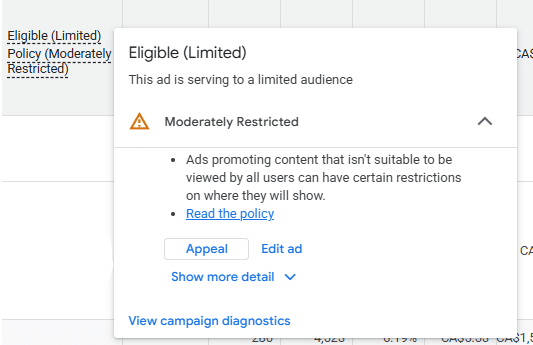
Note that you may see warnings such as “Eligible (Limited). This is normal for the healthcare space. As long as you follow the policy, your ads will still run properly.
You don’t need any special certification to advertise talk therapy, counselling, or psychotherapy for anxiety, depression, relationships or grief . These are all standard therapy services. But if you’re offering addiction treatment you’ll need LegitScript certification or your ads won’t run. Knowing this avoids ads being disapproved.
Google Ads Campaigns That Work for Counselling Clinics
Not every type of ad campaign suits a therapy practice’s advertising budget. Some are built for ecommerce, not the anxious decision of booking a first session.
Search Campaigns As Your Primary Lead Source
Google Search ads should be the foundation of any successful Google Ads campaign for a counselling clinic. It is the strongest option for most local PPC campaigns in the service industry. A well-built search campaign means your practice appears prominently in search results for the exact problem potential clients are typing in, like “anxiety counsellor near me” or “couples therapy in Calgary” – high-intent searches from people ready to book, not just browse, which tends to produce the lowest cost per lead of any campaign type.
Set up the account around tightly themed ad groups, one for anxiety, one for couples counselling, one for grief, so each ad and landing page is tailored to the problem someone searched for. This is one of the safest ways to run Google Ads for a therapy practice for the first time, and one advantage Google Ads offers over waiting on referrals alone is speed.
When To Use Performance Max
Performance Max can work if you’re an established clinic with a decent conversion rate and a steady flow of clients, since this kind of advertising campaign automatically splits the budget across Search, Display, YouTube and Gmail.
The catch is control: PMax decides where the ads show, and for sensitive categories like mental health services, that can mean ads appearing in places that aren’t exactly a good fit for a therapy audience. New clinics are usually better off building Search first and layering in PMax once they’re up and running and have some steady conversion data.
Why Display and Video Ads Often Waste Budget
Display and YouTube campaigns are built for awareness, not for someone deciding to book a counsellor today. Banner ads and video pre-rolls reach people searching the web for all kinds of things, not specifically people actively searching for therapy, which usually means more website traffic from the wrong audience and a higher cost per booked session. Unless you’ve got a big advertising budget to spare for long-term branding, it’s almost always better to redirect that spend into Search ad campaigns.

Working out a Budget and Bid Strategy for Your Counselling Clinic’s Advertising Efforts
Ad spend is usually the first thing people ask about when they’re trying to land new clients, and the answer depends on the market.
What Do New Clients Cost?
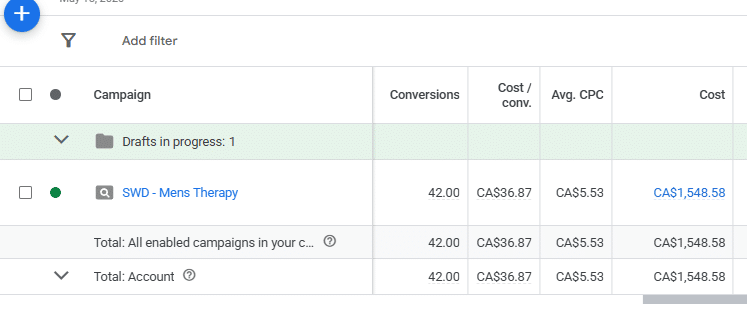
Cost per click for therapy and counselling keywords in Google Ads can range from $3.74 to $10 in hot spots like Toronto or Vancouver, but smaller cities tend to be cheaper. A $30 daily budget can yield 240 to 300 monthly clicks a month.
A well set up campaign can start to generate inquiries within 30-60 days. With a good landing page you can expect to pay around $80 to $200 for a lead, and maybe double that for an actual booked client once you factor in no-shows and dead-end inquiries.
The average client is often worth well over $1,000 over the lifetime of their treatment, so that math tends to work in a therapy practice’s favor even if the per-click fees feel steep at first.
Recommended Advertising Budgets by Market Size
As a rough starting point, clinics in smaller markets should be able to see results with $1,000 to $1,500 a month, while bigger cities might need a bigger marketing budget, more like $2,000 to $4,000 just to stay competitive.
Multi-location practices or clinics with a bunch of counsellors will need to budget even more to land new clients across every location, since each clinician multiplies the lead volume needed. Give new ad campaigns a few weeks to get going before you start judging how well they’re doing.
Smart Bidding vs. Manual CPC
Manual CPC gives you more control early on in Google Ads, including settings like whether to include Google Search Partners, which can be useful while you’re still figuring out what keywords and ad groups actually produce booked sessions.
Once your conversion tracking shows 30 or more conversions in the last 30 days for your ad campaigns, you should look to switch from manual bidding to a maximize conversions strategy.
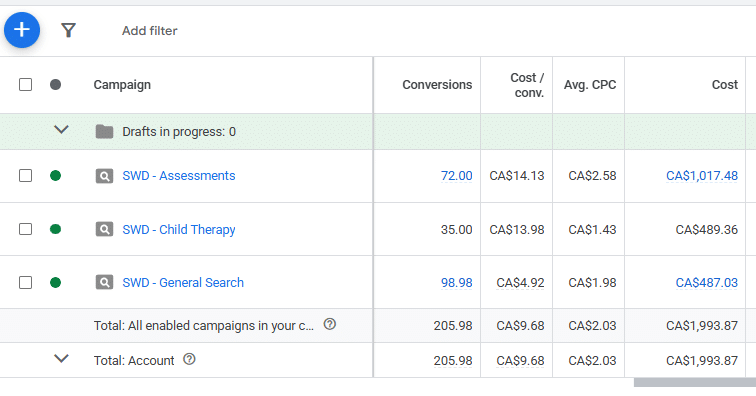
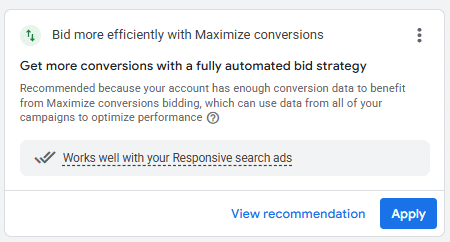
You might see Google recommending to switch to Max Conversions early in a campaign. It’s important to gather enough conversion data first before following this recommendation.
When to Switch to Target CPA
Target CPA makes sense once you know roughly how much new clients are worth to the practice and have settled on a target cost per booking the numbers can support. You’ll also need enough conversion tracking history for Google to start optimising against that number.
Switching too early tends to make Google under-deliver on impressions while it searches for a pattern that isn’t really there yet. A safe rule of thumb is to wait until conversions have been steady for at least a month under Maximize Conversions before trying a Target CPA goal.
Google Ads Strategy for Counselling Clinics
Keyword selection is key to any Google Ads campaign, since it decides who sees your ads in the first place. Local search intent is really important in a space like this.
High-Intent Keywords That Convert
The Google Ads keywords that work best are specific and action-oriented: “anxiety counsellor Vancouver”, “anxiety therapy Toronto”, “marriage counselling near me”, “grief therapist”, “online therapy Alberta”.
These are individuals actively searching for help right now, not just researching mental health issues in general. Broad keywords like “therapy” or “counselling” get a lot more clicks, but a lot of that traffic comes from irrelevant search terms that were never going to book a session, which drives up the cost per lead. Using exact match on your highest-intent terms keeps things tighter.
Set up separate ad groups around high-intent phrases, each with matching copy and landing pages, and they’ll tend to outperform one broad campaign trying to capture everything at once.
Service-Specific and Modality-Based Terms
Beyond searching for specific issues, also include specific keywords tied to particular therapy services and approaches: EMDR, CBT, trauma therapy, trauma-informed therapy, family therapy, teen therapy, or online therapy marketing terms if you offer remote therapy.
These terms tend to attract less competition and cost less per click than generic terms, but still attract clients who already know what kind of support they’re looking for. Teams made up of mental health professionals should reflect that in their keyword and marketing copy too, since your target audience often searches by specific credentials.
Negative Keywords You Can’t Afford to Ignore
Negative keywords protect your ad spend from clicks that are never going to turn into actual clients: “free therapy”, “jobs”, “training”, “courses”, and “how to become a counsellor” all attract job-seekers, bargain-hunters or students rather than people looking for actual help.
It’s also worth excluding “physical therapy”, since broad therapy terms can sometimes pull in the wrong kind of clicks. It’s a good idea to also exclude crisis terms like “mental health hotline” if the clinic isn’t geared up to deal with emergencies. This is not only about protecting your spend, but also about making sure that someone in a crisis gets directed to the right resource right away.
Descriptions and CTA’s for a Sensitive Audience
Once you’ve got a keyword foundation in place, the ad copy needs to do two jobs at once: rank well and sound right.
Headlines that Get Clicked
A good Google Ads headline speaks to the problem someone was searching for, rather than just describing the therapy practice in general terms. “Struggling with Anxiety? Come and talk to a counsellor today” tends to work better than say “Welcome to [Clinic Name]”, because it uses language that mirrors what the visitor is thinking.
A good google ads example is one that pairs a problem-focused headline with the area or region in at least one line which improves relevance and click-through rate. It’s also worth testing multiple ads within each ad group to see which headline lands best, since a focused campaign built around your ideal clients usually beats a scattershot one.
If you’re wondering how to write a google ad that actually gets clicked, try starting from the perspective of your therapy clients: what are they feeling, and what’s the smallest next step you can offer them.
Descriptions and CTA’s
Descriptions should make things easier for someone who’s nervous about getting in touch. Mention the things that matter: free consultations, sliding scale fees, virtual sessions, or how quickly they can book.
Try to avoid writing anything that sounds like “don’t wait!” as that can be a bit jarring for a target audience that’s already managing anxiety. Clear calls-to-action on landing pages can boost client inquiries. CTAs work best when they’re low-stakes: “Book a Free Consultation” or “Send a Message” tends to convert better than “Call Now”, because it gives people more control over how and when they get in touch.
Landing Pages that Actually Work
Even a well-built Google Ads campaign will fall apart if the landing page doesn’t do its job. It is essential to understand the importance of a well built landing page.
What Every Counselling Landing Page Should Include
A page built for counselling clients needs more than just a contact form. At the very least, it should have a clear headline that tells website visitors what they can expect; a short explanation of who the service helps and how sessions work; visible counsellor credentials and photos, plus a couple of client testimonials.
Trust is a huge factor in choosing a therapist. You will need a simple way to book; and a note on cost, including details about sliding scale fees or insurance billing. Pages that bury this information, or send ad traffic to a generic homepage instead of dedicated landing pages, tend to convert at a lower rate.
Tracking and Optimising Campaign Performance
Without conversion tracking and ongoing optimization in Google Ads,you won’t be able to fully understand what is working, and what your ROI is.
Setting Up Conversion Tracking
You need to track conversions, whether it’s lead form submissions, phone calls (ideally using call tracking, like Callrail, so you can see which keywords drive the call, and what your clients are actually searching for), or booking confirmations through Janeapp. These should all be tagged using Google Tag Manager or your Google Ads tracking code.
Using Google Ads conversion tracking alongside Google Analytics will give you a much clearer picture of what happens after someone clicks your ad. Skipping this is the most common reason why clinics come to the conclusion that Google Ads just doesn’t work for them.
The Metrics That Matter Most
Click through rate and impressions are useful, but cost per lead, whether that’s a phone call or form submissions, and cost per booked client are what really tell you whether or not your campaign is producing a positive ROI.
Frequent reviews of your search terms reports are important, as you’ll often find that the actual phrases triggering your ads aren’t what you originally thought you were targeting. Your Google Ads dashboard makes all of this easy to check in one place.
How Often to Review and Adjust
Once your ad campaigns are up and running, weekly check-ins are a good idea, just to see what’s not working and where you can reallocate budget to make the most of your best performing keywords.
On a monthly basis you should be doing a bit of a deeper dive, looking at how your search terms, landing pages, campaign structures and bidding strategy are all performing. Try to avoid making too many changes on a daily basis. Google’s algorithms need a bit of stability to learn from, and too much change will end up resetting that learning rather than actually improving it.
Why Counselling Clinics Choose to Partner with Salt Water Digital
Running successful ads for a therapy practice is about more than just setting up the technical side of Google Ads. It’s about actually understanding who you’re trying to reach.
PPC Marketing Without the Guesswork
We focus on digital advertising and digital marketing strategies built specifically for your audience, not generic templates.
At Salt Water Digital, we build ad campaigns that genuinely reflect this, from ad copy that takes into account the policies and guidelines around mental health marketing to keyword strategies that are focused on actually reaching out to potential clients, rather than just trying to get a high click through rate.
That’s the real difference between generic Google Ads for therapists and a strategy built around how people actually choose psychological care.
If you are interested in getting started on your Google Ads journey, book a strategy call with our team and see how we can help you find more potential clients.