Google Ads is one of the most powerful tools available to physiotherapy clinics looking to grow their patient base. Unlike advertising on social media where you’re putting your message in front of people who may or may not need your services, Google Ads connects you with potential patients who are actively searching for physiotherapy right now. Done correctly, it can be a scalable system for generating new bookings every month.
The below guide will walk you through everything you need to know, from understanding costs and timelines to building and optimising your campaigns step by step.
Key Takeaways: Google Ads for Physiotherapy Clinics
Google Ads puts your clinic in front of patients at the exact moment they’re searching for physiotherapy services.
Most clinics will spend between $1,000–$5,000 per month on ad spend, depending on their market size and goals.
It typically takes 60–90 days to see consistent, optimised results. This allows Google to get as much data as possible, and alter the algorithm to put your ads in front of an audience that has a high chance of converting.
The right campaign structure, keyword strategy, and landing page are the difference between wasted budget and a positive ROI from appointment bookings.
Accurate conversion tracking is absolutely necessary. We track appointment bookings through Janeapp, as well as calls and form submissions depending on your lead funnel.
Why Google Ads Works for Physiotherapy Clinics
- Reach Patients who are actively searching
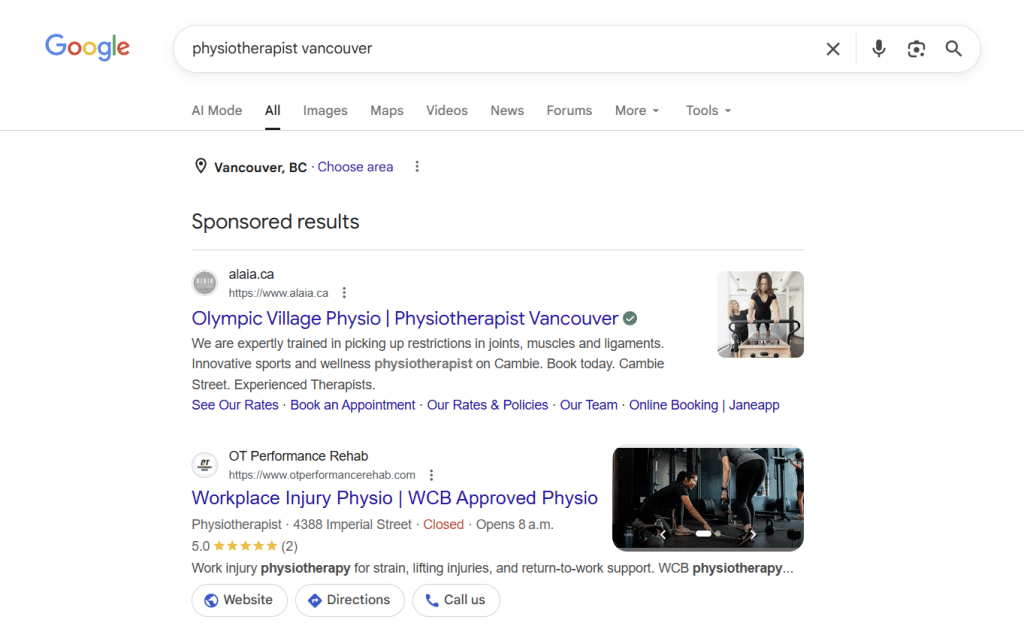
When someone types “physio near me” or “back pain physiotherapist” into Google, they are ready to book an appointment. Google ads will place your clinic at the very top of those search results, as soon as you activate your ads. This differs to local SEO which may take months to build your organic strength to show at the top. For a service-based business where demand is driven by urgency, this intent-based advertising is very effective.
- Build Local Brand Awareness
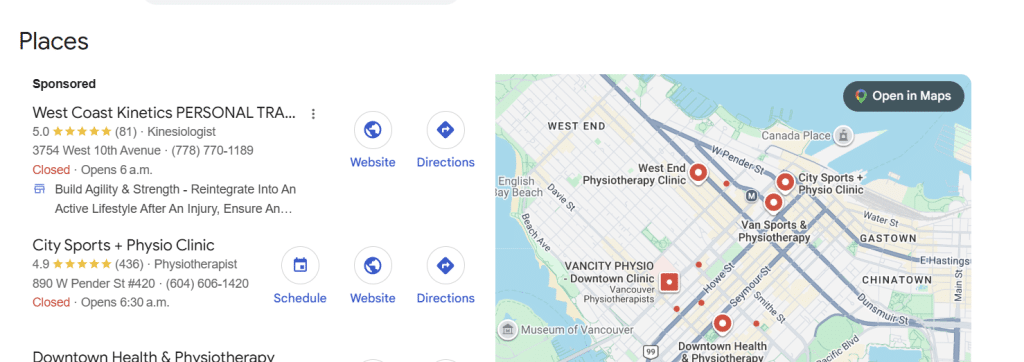
Showing at the top of a Google search page as well as the local map pack can make your brand look really strong. If you are repeatedly seen at the top when people search for your services, the repeated exposure can build brand familiarity and trust so that when the user is ready to book, your brand is at the forefront of their mind. Google Ads doesn’t just drive immediate bookings; it steadily builds your reputation within the communities you serve.
- Control Your Budget and Scale Results
Unlike traditional advertising, Google Ads gives you complete control over your spend. You set a daily budget, choose your maximum cost per click, and can pause or adjust campaigns at any time. As you identify what’s working (which keywords, which ads, which locations) you can scale your budget and start to grow your patient volume with data to back up your decisions.
How Much Does Google Ads Cost for a Physiotherapy Clinic?
Costs vary depending on your location, local competition, and how aggressive you want to be in the market. As a general benchmark, most physiotherapy clinics invest between $1,000 and $5,000 per month in ad spend. If your clinic is in a competitive city, you may need to be at the higher end of that scale to compete effectively. If you are in a smaller market, then you can achieve strong results with a more modest budget.
The metric that matters most is cost per new patient booking. If you’re spending $2,000 per month and generating 25 new bookings, your cost per acquisition is $80. When each patient represents $400–$1,000 or more in lifetime revenue, that return on investment is very difficult to argue with.
How Long Before Google Ads Generates New Patient Bookings?
We always say to expect a learning phase of 4-8 weeks before campaigns start to show their real potential. During this time, the Google Ad’s algorithm is gathering data about which ads, keywords and audiences will drive the best results. You’ll usually see some bookings coming in during that phase, but the overall performance will improve meaningfully once the campaign has enough data to optimize against.
By month three, you should have a clear understanding off your top-performing keywords, a developed negative keyword list and an understanding of the cost per booking. Most clinics will see their best ROI around the three to six month mark, when campaigns have been tested, optimized, and there is a foundation of real performance data.
Is My Physiotherapy Clinic a Good Candidate for Google Ads?
Google Ads can work for your clinic if you have:
- A professional, mobile-friendly website — or a willingness to build a dedicated landing page
- A clearly defined service offering
- A reliable process for answering inbound calls and enquiries promptly, ideally the same day
- A commitment to running campaigns for a minimum of three months to allow for proper optimisation
- A budget of $1,000+ and an understanding of your customer lifetime value
It is important to have the capability to answer additional calls a day, one of the biggest conversion actions we see in this space is phone calls. If your team does not have the time to answer these calls at a solid answering rate then we always suggest putting a system in place to deal with the extra volume before starting.
Google Ads Case Study: What We Focus On for Physiotherapy Clinics
We recently completed a case study on one of our physio clinic clients.The results below were seen in that three to six month window:
- Conversion rate (Acupuncture): 31%
- Conversion rate (Physio/Kinesiology): 33%
- Cost per confirmed booking: $58
- + an additional 190 tracked phone call conversions
You can read more about the results achieved, and our strategy here: https://www.saltwaterdigital.com/google-ads-physiotherapy/
The fundamentals that drove those results are consistent across every clinic we work with: precise targeting, relevant ad copy, strong landing pages, and data-led optimisation.
Types of Google Ads Campaigns for Physiotherapy Clinics
- Search Campaigns
This is the absolute most important campaign for your clinic’s Google Ads strategy. This will be where the bulk of your budget and focus should be, especially in the early stages. Search traffic represents the highest intent audience available. - Display Campaigns
Display campaigns show visual banner ads across Google’s vast network of partner websites. Display campaigns on their own will very rarely drive new patient bookings. They are mainly used as a remarketing tool, targeting people who visited your website but did not book an appointment. If used alongside search, they can help recapture some warm leads. We would only recommend these campaigns if we had additional budget, and were already capturing the majority of search traffic. - Performance Max
Performance Max is Google’s AI-driven campaign type that runs across Search, Display, YouTube, Gmail, and Maps simultaneously. For clinics with existing conversion data in their account, PMax can be an efficient way to expand reach. For newer advertisers without that conversion history, it’s better to start with Search campaigns and introduce Performance Max once Google has enough data to work with. It is referred to as a blackbox though as most of the data is hidden from the account manager. If managed correctly, it can supplement a successful search campaign. - Local Services Ads
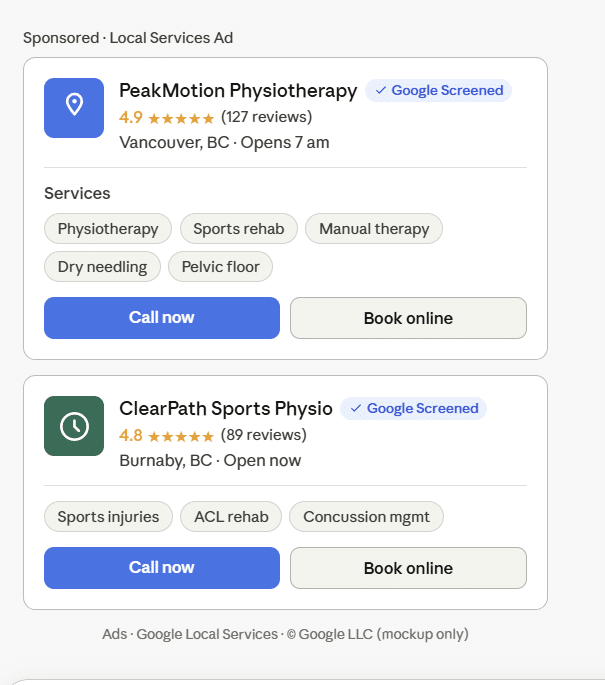
Local Services Ads appear above traditional search ads and carry a “Google Guaranteed” or “Google Screened” badge which can build quite a high level of trust with searchers.
LSA’s operate on a pay per lead model rather than pay per click which can make them highly cost-effective. Again, they can work well beside a search campaign as you can dominate the SERP. There is very little management involved but we can advise on set up.
How to Build a Google Ads Campaign for Your Physiotherapy Clinic
Step 1: Define Your Goals and Target Patient
You will need a clear idea of what you want to achieve before you start advertising on Google. Are you trying to get more appointments for your Physiotherapist or acupuncturist? Did you recently hire a new sports physiotherapist and you want to drive more appointments that way? Every other decision will be made with this goal in mind – keywords, ad copy, landing page etc. Sometimes, if you dont have a big enough budget you will need to focus on one service rather than very service you offer so as to not dilute the search traffic.
Step 2: Understand Your Competition and Market
Do your keyword research and see what other clinics in your location are doing. What services do they target? Compare landing pages to see if you believe they have something stronger that you can adopt. Use this research to find gaps that you can take advantage of and position your clinic offering in a more compelling manner.
Step 3: Research and Select the Right Keywords
Focus on high-intent, service-specific keywords such as “physiotherapist [city]”, “sports injury physio near me”, or “back pain physiotherapy clinic”. Use Google’s Keyword Planner to assess search volumes and competition levels. Avoid overly broad terms that will attract clicks from people searching for jobs, courses, or unrelated information. If you hire a marketing agency, they will do all of this research for you.
Step 4: Set a Realistic Budget
This will come from your research phase. You will learn the cost per click in your market, and base your initial budget off that. For most clinics, a starting point of between $32-$65/day is strong. Once you have enough data, you can adapt this ad spend to the market demands.
Step 5: Build Your Negative Keyword List
Negative keywords prevent your ads from showing for searches that aren’t relevant to your clinic. Common negatives for physiotherapy include terms like “free”, “jobs”, “salary”, “courses”, “DIY”, and “home exercises”. It is also good to include your brand name and competitors names as negatives to ensure you are targeting new, high intent traffic. A well-maintained negative keyword list is one of the highest-impact ways to reduce wasted spend and keep your campaigns focused.
Step 6: Write Compelling Ad Copy
Your ad copy is going to receive a rank from Google, the higher this rank, the more often your ad will show. Google wants to see certain things in the ads; your keywords, landing page copy, unique terms etc. Aim for a score of Good-Excellent for best results. Use Google’s Dynamic Keyword Insertion which will replace the ad headline with the keyword that the user searched.
Step 7: Add Ad Extensions
Ad extensions expand your ads with additional information:
- Call extensions – your phone number
- Sitelink extensions – links to specific services or your booking page
- Location extensions – your clinic address
- Callout extensions to highlight key selling points like “Evening Appointments Available” or “Direct Insurance Billing”.
All of these things will increase your visibility, rank and click through rate (CTR).
Step 8: Decide on a Landing Page
When it comes to where you send your ad traffic, you have two options: a dedicated landing page built specifically for the campaign, or the relevant service page on your existing website.
There’s no “one size fits all” answer. In some cases, a purpose-built landing page significantly outperforms the website; no distractions, focuses on a single call to action, and is designed to convert. In other cases, a well-developed service page with strong content, and clear booking options holds its own or even performs better. The honest answer is that it depends on the quality of what you already have.
If your service pages are thin on information, lack social proof, or aren’t structured to entice a visitor toward booking, build a dedicated landing page. If your website is already well polished, informative, and conversion driven, start by sending traffic there. Either way, A/B test both options and let the data tell you which one is turning more clicks into booked appointments
Step 9: Set Up Conversion Tracking
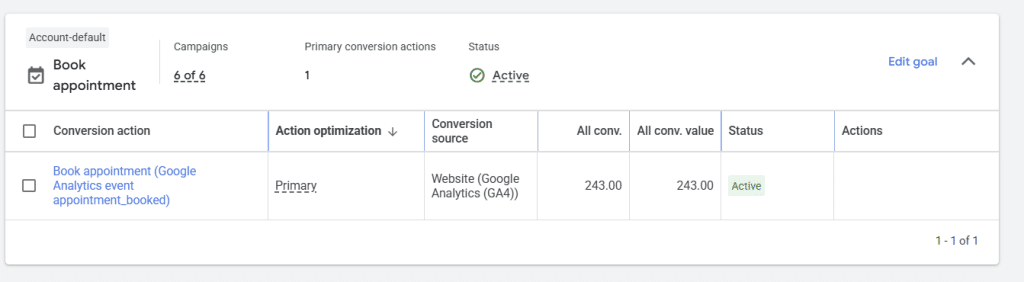
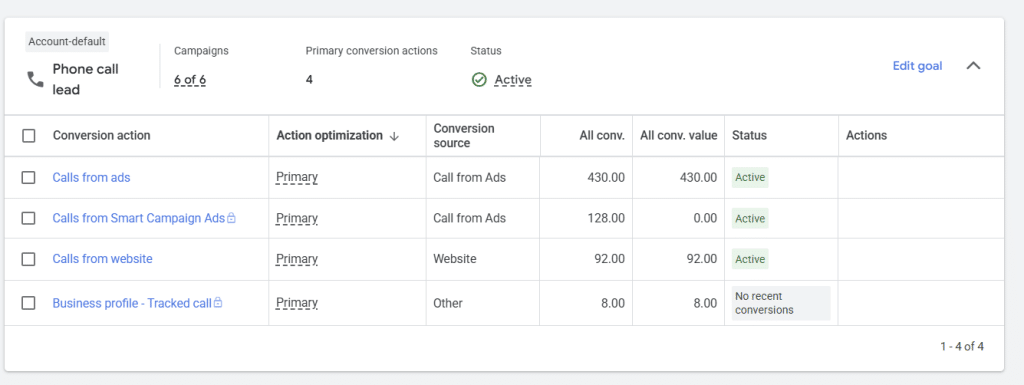
Conversion tracking tells you which keywords, ads, and campaigns are actually generating bookings. Set up tracking for phone calls, contact form submissions, and online booking completions. Without this data, every future account decision is guesswork.
PPC Management and Tracking for Physiotherapy Clinics
Effective Google Ads management requires consistent, structured attention. On a weekly basis, this means reviewing search term reports, monitoring budget pacing, and flagging any significant shifts in click-through or conversion rates. Monthly reviews should cover deeper performance analysis, keyword bid adjustments, ad copy testing, and clear reporting on cost per booking trends over time.
Conversion tracking should be audited regularly. Broken tracking is more common than most clinic owners realise, and it leads to budget decisions built on incomplete data. You will need to set up cross domain tracking on GA4 so that you can track appointments being booked on Janeapp. Here is a guide for that: https://jane.app/guide/google-analytics
Saltwater Digital: Google Ads Services for Physiotherapy Clinics
At Saltwater Digital, we specialise in running Google Ads for physiotherapy clinics across Canada and the United States. We handle everything from initial campaign strategy and keyword research to ad copywriting, landing page recommendations, and ongoing performance management, with transparent reporting at every stage.
If you are ready to start advertising on Google, showing in the top search results and getting more booked appointments then book a call with one of our PPC specialists today.